
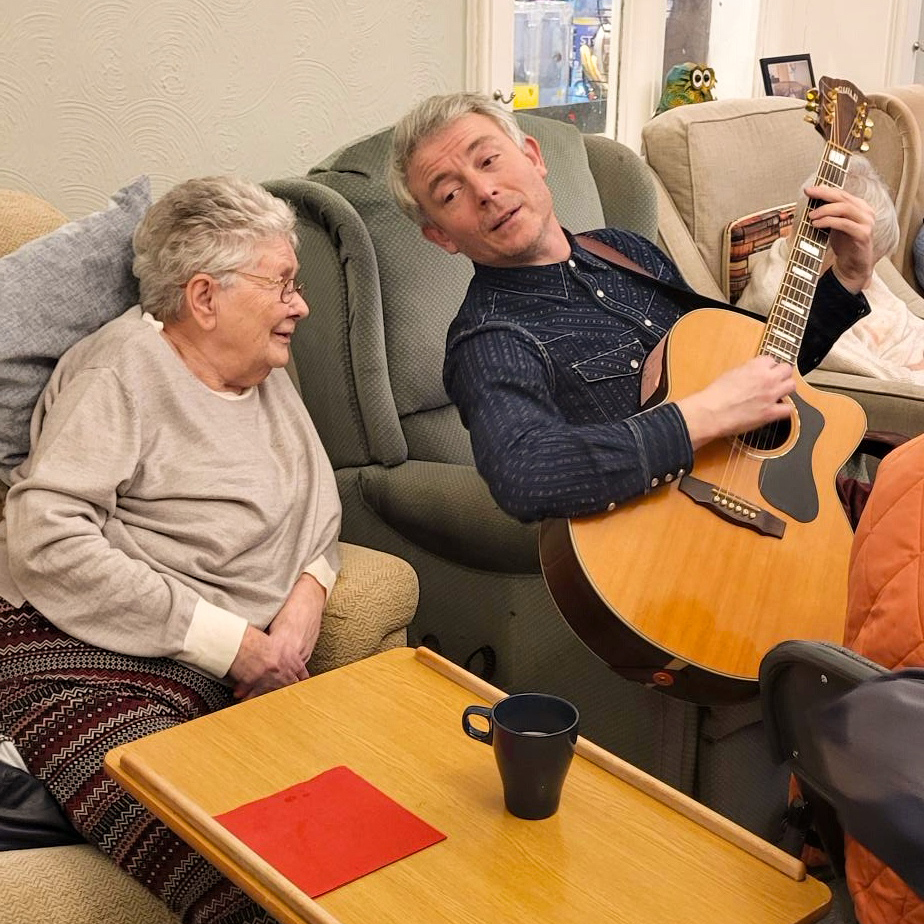
In this blog, George Williams, a musician in residence at the Southern Healthcare Butterfly and Dragonfly care homes in Devon, talks about the importance of live music in care homes and he explains the huge benefits of his regular visits to the homes with his double act Dotty the dog.
The original blog was published by Meaningful Care Matters, a global organisation whose mission is to improve quality of life and lived experience for all people in health and social care service.
Southern Healthcare in Devon has four nursing homes that have achieved Butterfly and Dragonfly Accreditation. The homes have a professional band playing regularly and many musicians visiting, but Meaningful Care Matters auditors were particularly impressed by the organisation’s investment in employing George, a musician and actor on the payroll, enabling him to become an integral part of the team and helping to provide live music in care homes belonging to Southern Healthcare.
This has allowed George to build a special and significant relationships with people living and working in the homes over several years and to take a flexible, creative and personal approach to playing live music in care homes. His role goes far beyond that of an ‘entertainer’. It is much less about performing at the front of a room and far more about being a friend with a guitar, spending meaningful time together.
Wouldn’t it be wonderful if more care providers considered making this vital investment in music in care homes and hospitals?
Providing live music in care homes is vital to wellbeing. This is George’s story of how it came about and what the work means to him.
‘Ah, my nan’s care home had live music — she loved it!’
‘Music always brought Dad out of himself.’
‘That must be a really rewarding job.’
These are the kinds of responses I repeatedly get when I tell people I play live music in care homes. But whilst I’ve managed to carve out something vaguely akin to a career in the performing arts, I haven’t always felt quite the same sense of pride and purpose when explaining what it is I do for a living.
Over three decades I have been a jobbing actor, a vocalist, a music creator, a theatre maker. Time and again I’ve seen people’s eyes light up when they ask what it is I do.
‘Ooh, an actor — have I seen you in anything?’
‘A musician — are you famous?’
Sometimes a conversation is sparked. Most of the time, those same eyes quickly dim and wander as I attempt to explain the ad hoc affair that it can be making a living as a performer. And quite rightly so. It is, for the most part, not glamorous and, furthermore, a notoriously precarious occupation. That precarity is intensified by it being a vocation — a way of being where identity and income are all tied up together.
Cut to Brighton in the early 2000s. The London-on-sea party destination was not just my home but also a hotbed of opportunity for a nascent professional musician. I dived straight in. It wasn’t long before I was doing several gigs a week — sometimes two a night. But a few years down the line, I discovered, to my dismay, that fronting bands and singing at corporate events and private functions — whilst providing me with an income — was making me quite unhappy.
I stepped away from it all, certain that fulfilment was to be found in more ‘discerning’ areas of the industry. It would be another decade or two before I discovered it was the context, not the content, that was causing my existential crisis.
Fast forward to early summer 2022. I found myself on another day of job hunting, having a stilted conversation with a busy administrator at a one of the homes belonging to the Southern Healthcare group.
‘Musician in Residence job? Sorry, don’t know anything about it.’
‘It’s been posted today on Indeed,’ I proffered eagerly.
In my haste to be considered for the role, I was evidently bypassing the correct application process. I soon came to learn that my enthusiasm was almost on a par with the job post’s author. The lack of knowledge of such a vacancy was because such a position did not currently exist at the time — except in the vision of the managing director with a passion for live music.
I got the job. Or at least I thought I had.
I met with Geoffrey Cox, MD of Southern Healthcare. He explained how he wanted to expand the provision of live music across the homes. It was the tail end of the pandemic. Whilst there had been some return to normality, there was still significant disparity in the delivery of activities. What he was envisioning sounded like an innovative approach. I was chuffed to bits.
A few days later — some hesitation. There’d been pushback from concerned staff. A musician on the payroll? In-house, across all four homes? How would that be co-ordinated?
“Surely there are more essential assets to be procured before some minstrel starts wandering willy-nilly around the place, Mr Cox? Someone to drive the minibus, for a start?”
Valid points indeed, but not in tune with this vision.
Luckily for me, such was the maverick spirit and boundless enthusiasm of Mr Cox that a trial period was agreed upon. This luck continued as probationary weeks turned into months, and months rolled into years. Rock and roll!
I must say I did go into it armed and prepared. I had an extensive, varied repertoire from all those years on the circuit. I had a clear vision of how I wanted to present myself. All that busking and immersive theatre had shown me I could engage without the need to plug anything in. And when you are free of such restrictions, you also have an additional instrument at your disposal — your own body.
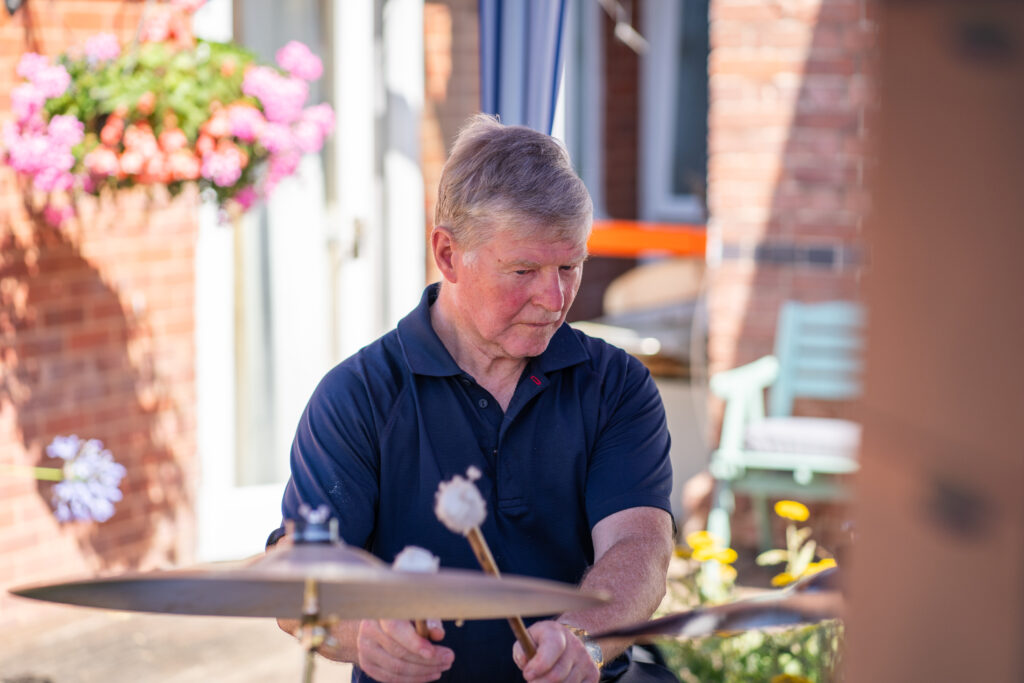
Measuring success moment by moment
But stepping back, what is the hard evidence on the effectiveness of live music for wellbeing? What measurements can be used to determine effectiveness? Where is the solid data that will reassure stakeholders — namely residents and their families — that they are receiving value for money when that singer and his dog come tumbling yet again into the lounge?
I know it won’t win over all economists, but here are some examples of what I have witnessed time and again when we rock up:
June’s* soulful singing and sharp-as-a-tack comebacks.
Alice’s* elegant footwork and raised eyebrows.
Julia’s* all-in dancing and all-out teasing.
Harriet’s* measured tapping and withering looks.
Fred’s* rattling — both his tambourine playing and his leg-pulling of yours truly.
Over four years and, in both character and geography, across four distinctly different homes, I have experienced on a regular basis the magic that happens when you can provide a song, a beat and a bit of banter.
Making things personal
Making weekly visits means I get to personalise sessions and really know people. I learn that Sally* will suddenly become animated at the opening line of Don’t Fence Me In. I remember that Somewhere Over the Rainbow will make Belinda* tearful (in a nice way); that Dedicated Follower of Fashion will make Fred’s eyes sparkle, eliciting memories of sauntering through Soho in the 60s.
Quite often, I will improvise, including suggestions and contributions from people in the moment, which brings that extra sense of feeling heard and included. It means I can adapt my set, my delivery and even my whereabouts depending on who is present — in the lounge, the garden or their own room. And of course, that’s not just residents but, importantly, team members and visitors alike.
This all leads me back to my ‘gigging days’. It was the context. Being up on stage, surrounded by speakers, stands and cables, made me feel detached — from audiences, even from my fellow musicians. What I craved was a return to the environment where I first started singing and playing: a living room populated by friends and family. A space where removing the pressure to perform allows the music to be heard, where thoughts can be aired and ideas bounced around. It’s truly personal.
An unexpected double act
Ah, talking of bouncing — there is a being I’ve only briefly mentioned thus far. My dotty collie-springer cross, Dotty, is my co-performer. What started as a one-off necessity became an absolute fixture. And she, of course, brings her own brand of connection.
Unsurprisingly, she is ball-mad. And as far as Dotty is concerned, where there are people, there are ball-throwers. Drop into the mix a job lot of repurposed litter-picker grabbers and it’s not just songs and chats being thrown about the place.
So yes, these days I feel pride and purpose when I tell strangers what it is I do. And I am forever honoured and humbled by the people and communities in whose homes I get to hang out — throwing out energy and seeing what comes back. Give me that any day over some polite yet disengaged round of applause.
So, with that in mind, it is only right that I leave the last word to Nick* — a true hero and a true heckler.
I met Nick at in one of the homes early on in my employment. He was someone who was very much not going to let himself be defined by a condition — a defier of self-pity. He was also an expert in the well-executed insult. He made me laugh.
When I tentatively invited requests, Nick would shout song titles suggesting I should pack up my troubles and go forth and multiply. If I attempted a bit of nice-guy chat, he’d tell me to “shaddap your face” and get on with it.
“Go home!” he’d say with a beaming smile.
It was then that I realised that, in this job, I have done just that.
George Williams
*names have been changed